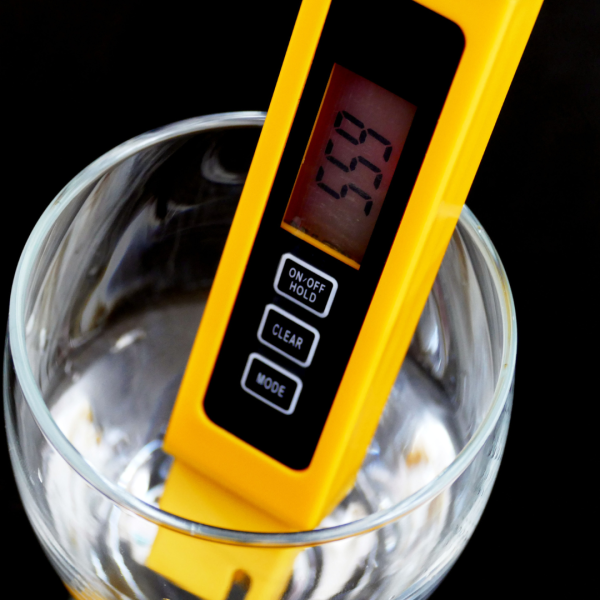
Is it reliable to use a PPM reader to evaluate the effectiveness of a water filter/purifier?
%20(13).png)
It is important to note that a water filter does not work like a reverse osmosis system. The main purpose of a water filter is not to remove all solids from the water.
The filters in water purifiers are designed to preserve the natural mineral salts present in the water.
What elements are not measured by a TDS / PPM reader?
A TDS meter, or PPM reader, does not measure contaminants, and therefore does not provide a direct indication of the safety of the water.
Some beneficial minerals like potassium, magnesium, and calcium can lead to high PPM readings. As a result, the use of a water filter with a remineralizer can produce the opposite effect expected on a TDS meter.
In addition, the water may contain heavy metals such as lead, as well as other contaminants such as pesticides, pharmaceutical residues or hexavalent chromium, which the TDS meter cannot detect.
What is the purpose of measuring TDS / PPM?
It is essential to understand what TDS/PPM actually represents: total dissolved solids.
When water falls to the ground as rain, it dissolves the minerals present in the rocks and soil through which it passes, keeping them at various concentration levels in the water. This natural process helps to give the water a pleasant taste by slightly increasing its pH. The most common minerals found in water are calcium, magnesium, and sodium.
Regions may have different levels of these dissolved minerals in their water, which can make it more or less "hard". For example, our customers in Belgium, in the Liège region, or in France, in the Lille region, can have a water hardness rate of 40 French degrees, indicating a high limestone content.
A TDS level below 200 mg/L (or ppm) is considered good, and 100 mg/L is even rated as excellent. When TDS levels drop below these values (as minerals are removed), the pH of the water drops, making it more acidic or corrosive, which noticeably alters its taste. TDS levels above 400 mg/L are considered non-potable.
It is therefore crucial to know your TDS level when considering a salt-free water conditioner for your home. These devices can protect pipes and plumbing, reduce stains on dishes and shower doors, extend the life of clothes, etc., without resorting to salt or large water consumption.
It is worth remembering that a water filter is not a water softener, and its main purpose is not to remove all solids from the water.
A PPM meter often shows little change between the water before and after filtration. This is normal, as the measurement of total dissolved solids (TDS) includes various mobile charged ions, such as minerals, salts, or metals, dissolved in a given volume of water, expressed in mg per unit volume (mg/L), also known as parts per million (ppm).
What is the nature of a TDS measurement?
The TDS measurement, which represents the "total amount of moving charged ions, including minerals, salts, or metals dissolved in a given volume of water," is not an absolute indicator of water purity or the quality of the water purification system.
Indeed, if the objective of a water purification system was only to make water pure in H2O, this conclusion could be valid.
However, it is important to note that minerals are necessary for human health, so their presence in water is beneficial. An effective water purification system should filter out substances that are harmful to the body while preserving essential minerals.
When customers use a TDS/PPM meter, they often notice that the reading before and after the water passes through the filters usually remains unchanged. This is because filters do not remove all of the beneficial minerals from the water. They mainly remove unwanted heavy metals such as lead and mercury, as well as sedimentary minerals such as iron oxide and aluminum.
Therefore, the TDS reading does not vary significantly unless the water contains a significant amount of heavy metals or sedimentary minerals.
It is crucial to understand that the TDS meter does not measure the presence of biological and chemical contaminants. Therefore, it is unwise to rely solely on this measurement to assess water quality. Water with a low TDS content can contain harmful bacteria, while water with a high TDS content can be perfectly safe, such as pure, unpolluted seawater.
Understanding the Temporary Variation in TDS When Using Filters
Coldstream filters are specifically designed to preserve the essential minerals in your water, which is beneficial to your health.
During the first few uses, it is normal to observe a slight increase in TDS (Total Dissolved Solids), mainly due to two factors:
Fine particles of coconut charcoal : Black Berkey filter elements incorporate coconut charcoal, from which tiny particles, known as "coconut coal fines", can break off. Although these particles are completely harmless, they can be present in the initially filtered water and contribute to the temporary increase in TDS. This phenomenon is transient and usually disappears after the first flushes of the system.
Ion exchange media : Filters also use ion exchange media that release beneficial ions into the water. These ions, included in the TDS calculation, do not reduce water quality but rather indicate the presence of minerals that are essential to your well-being.
Is the increase in TDS indicative of a deterioration in water quality?
No, an increase in TDS does not necessarily suggest a decrease in water quality. TDS measurements do not discriminate between contaminants and beneficial minerals. Thus, an increase in TDS is often a sign of the preservation of essential minerals rather than an increase in contaminants.
What should I do if I see an increase in TDS with my filters?
This initial increase in TDS is a normal and expected occurrence. The initial steps are crucial to stabilize TDS measurements by removing excess particles and ensuring optimal filtration of your water purification system. Patience is key, because with time and continuous water filtering, the initial erosion of the filters will decrease. After filtering several hundred liters of water, this phenomenon will tend to dissipate.
Do Coldstream filters remove essential minerals from the water?
No, Coldstream filters do not remove essential minerals from water. Their goal is to filter out harmful contaminants while preserving beneficial minerals. They are designed to provide purified water, rich in essential minerals, which contributes to your health and well-being.
In conclusion, a slight increase in TDS during the initial use of the filters is a normal phenomenon. This is a result of the advanced design of the filters to purify the water while preserving its beneficial mineral qualities. These variations in TDS are temporary and should normalize with continued use and proper flushing of the system.