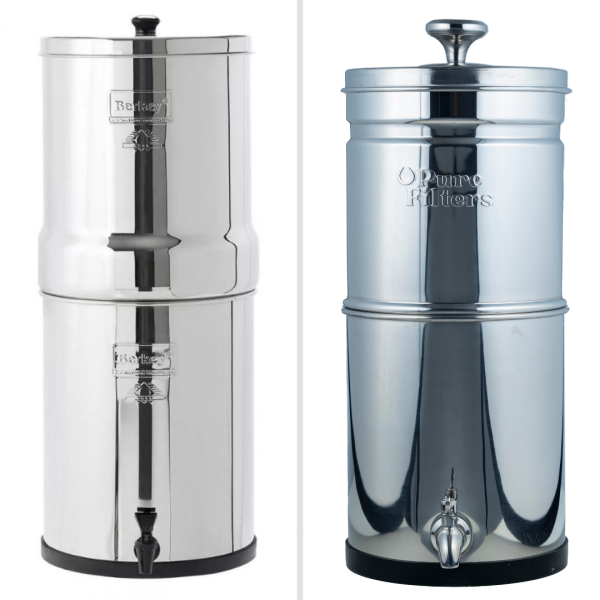
Pure Filters, our story: twelve years at Berkey
Pure Filters, our story: we have sold thousands of Berkey purifiers, today we don't sell a single one.
We started at the end of 2012. For a dozen years we were one of the main players in the Berkey market in Europe. Thousands of systems per year, entire pallets, a catalog built around a single brand.
We sold our last systems in 2024. Today, we don't offer any more.
Many people imagine a quarrel, or a scandalous discovery. That's not it at all. The story is more banal at the beginning, and much more interesting at the end, because it changed the way we work.
Berkey was a real reference
Let's start there, because rewriting history would be dishonest.
Berkey dominated the gravity purifier market for nearly twenty-five years. The product worked, the customers were satisfied, and we believed in it. We didn't sell it out of cynicism: we thought it was the best thing out there.
And to be absolutely clear, we still have confidence in Black Berkey cartridges today. We'll come back to that.
The real trigger was not moral, it was logistical
When the EPA's injunction came down in the United States, we found it absurd, as did just about everyone in the business.
But beyond the substantive debate, we very quickly understood something much more concrete: we would no longer have spare cartridges for our customers.
This is what happened, and in stages. The retail sale of cartridges first ceased, with the remaining stock of Black Berkey being reserved for complete systems. Then the Black Berkeys disappeared from the systems themselves: today, the brand's tanks are offered with Phoenix cartridges.
In other words, the cartridge that our customers had chosen no longer exists in the offer. Those who preferred to wait and see find themselves, three years later, with a system equipped with a filter that they did not choose.
However, a gravity purifier is not a one-time purchase. It's a tank that we keep for years and a cartridge that we replace regularly. A customer who had bought a system from us was left with no alternative.
We couldn't wait to see. We had to find something else, and quickly.
What we looked for, and why it matters
In 2023, we went in search of a replacement cartridge.
We could have looked for the cheapest, or the quickest to obtain, or the one that mechanically adapted without changing anything, or an aesthetically identical black cartridge. We chose another criterion: the best documented filtration quality, with real laboratory reports.
That criterion seems obvious written like that. It was not for us at the time, and it is not for almost anyone in this market. Yet it was he who determined everything afterwards.
That's how we discovered the technology Coldstream, made in the UK. It caught our attention, not for its promises, but for the thickness of its test file.
We went to see
Reading reports was not enough for us. We went there, at the KLT Filtration factory that manufactures Coldstream cartridges, and we have been back several times since.
We have seen the production lines, the raw material, the controls. We have asked our technical questions directly to those who manufacture the product, not to a sales department that forwards them. And we continue to do so whenever a technical point requires a precise answer.
This seems elementary for a distributor. It is not. In this market, many brands have never set foot in the factory from which their cartridges come out, and some do not know precisely where they are manufactured.
What we learned along the way
We didn't know how to read a lab report. We learned because we had to choose, and we don't make a serious choice without understanding.
We discovered the difference between a test carried out on a new filter and a campaign carried out in stages, with measurements spread over hundreds and then thousands of litres. This is the only way to know if a filter lasts over time, because a new filter media always works well. The real question is not what it does to the first liter, it's what it still does to the two-thousandth.
We've found that consistency matters as much as starting performance.
And we discovered that an analytical method and a performance standard are two different things. An accredited laboratory to measure a molecule is not the same as a test conducted according to a recognized protocol, which defines the duration, the flow rate, the water used and the criteria for success. Both are legitimate. They do not prove the same thing.
This apprenticeship was not included in the program. It has become our profession.
Then we made our own vats
The idea came in parallel. Since we were starting from scratch on the cartridge, we might as well master the container as well.
It took us six months: to receive samples, test them, compare them, correct them, and then order. Pure Filters was launched in April 2024.
The result that we monitor most carefully is that of the after-sales service. On our stainless steel tanks, we have hardly any reported cases of corrosion. For a product that contains water permanently for years, it is the criterion that counts, and it is not the one that is talked about in advertisements.
The transition didn't happen overnight, and we won't pretend otherwise. We sold our last systems from the old brand in 2024, while the new range was being put in place. A shift of this magnitude requires finding the technology, documenting it, redesigning the range, and explaining it to a network of dealers who also lived off the old brand.
Where we are today
We remain confident in Black Berkey cartridges. We now know precisely the differences between the two technologies, and we have detailed them in a dedicated article: What are the differences between the Black Berkey and Coldstream FTO+ filters ?
And here is what we can say today, with full knowledge of the facts. If the Black Berkeys were to return to the European market tomorrow, available at retail as before, we would continue with the FTO+.
Not out of spite, nor out of commercial comfort. Because even if we replace them every six to eight months, they perform better, and because we can show why.
It's a sentence that would have seemed arrogant to us three years ago. Today, it's simply documented.
The four questions to ask, including to us
You don't have to take our word for it. You have better things to do: ask everyone the same questions.
In front of any performance chart, ask how many liters the measurement was taken, and at how many different points. Ask who conducted the test, and who took the samples. Ask what water was used, and if its characteristics are indicated. Finally, ask what performance standard was applied, not just what method of analysis.
These four questions are not directed at anyone in particular. They work against the entire market, including us.
Ask us. We have the answers, and we send the documents on request.
To learn more, we also invite you to consult our tutorial: Guide to choosing the right water filter
That is the only promise we make. It is less spectacular than most of the promises in this market. It has the advantage of being verifiable.