
Understanding Coldstream FTO+ Filtration Results
How to read a filtration test: the case of fluorine and nitrates
At Pure Filters, we believe that transparency starts with a good understanding of the data. That's why we publish the full results of the tests carried out by Envirotek Laboratories (USA), an independent laboratory, on Coldstream FTO+ filters.
But reading an analysis table can be intimidating. Here are some key elements to better interpret the results, taking two examples that are among the most difficult to treat: fluoride and nitrates.
Why are fluoride and nitrates special cases?
Unlike other contaminants such as chlorine, bacteria or pesticides, ions such as fluorine (F–) and nitrates (NO₃–) are highly soluble and difficult to capture.
They require very specific filter media (usually based on activated carbon or ion exchange resins), and their reduction rate is highly dependent on the wear of the filter, the pH of the water and its overall composition. This is why these two parameters are very good indicators to objectively judge the real quality of a filter.
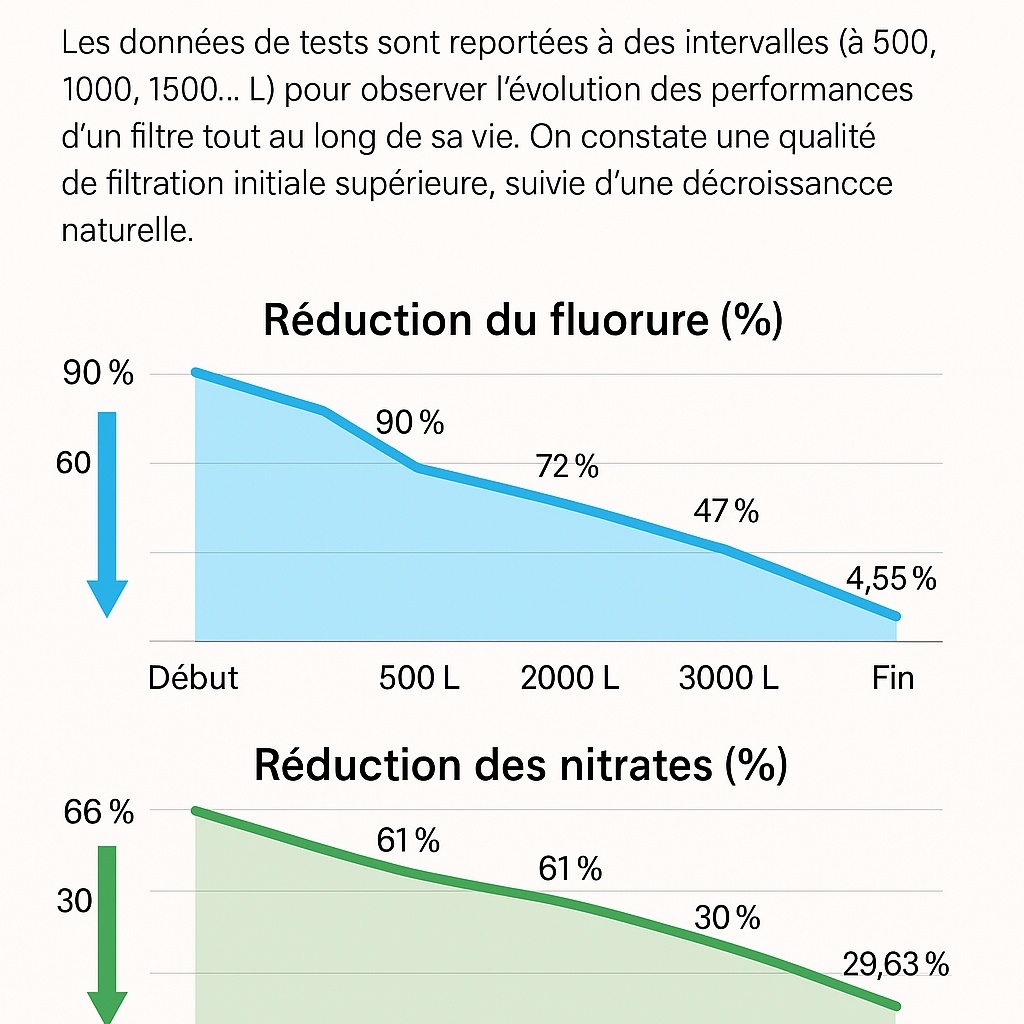
What the graph shows: Evolving performance
The results of the Coldstream FTO+ tests clearly show high efficiency at the start:
- Approximately 90% reduction of fluorine in the first 500 liters,
- More than 60% on nitrates at the same stage.
But over time, this efficiency decreases, as is always the case with activated carbon filters. At the worst point of the measurement series (2000 liters):
- Fluoride drops to about 4.55% reduction,
- Nitrates at about 29.63%.
At the end of the test (3000 litres), the measurements were 17.05% for fluorine and 59.6% for nitrates: the decay is not linear, and this is precisely what a test conducted until the media is completely worn out, step by step.
This data is not a weakness, but proof of an in-depth test, up to the maximum wear of the filter media. This is the lowest point of the curve that we retain in our communication — the real worst-case scenario, not the most flattering figure.
The main takeaways
• The Coldstream data sheet is not misleading: it announces a maximum capacity, as all manufacturers do.
• Pure Filters specifies that this capacity mainly concerns microbiological filtration (viruses, bacteria, cysts).
• For effective protection against chemical contaminants (such as fluorine, nitrates, PFAS), we recommend replacing the filters every 6 months or 1500 liters.
• And yes, we say it clearly, unlike other brands that only publish 10L tests. Our chart shows you why.
Our commitment is to provide you not only with high-performance filters, but also with the tools to understand their results and limitations. Because a well-understood filter is a well-used filter.
And what about other contaminants?
Laboratory results show that Coldstream FTO+ filters are particularly consistent on many other pollutants:
• Chlorine, VOCs, HAAs: Lifetime reduction of more than 95%.
• Pesticides, herbicides, pharmaceutical residues: very good stability as well.
• Heavy metals: reduction varies depending on the metal, but is effective at the beginning of the cycle.
• Microorganisms (viruses, bacteria, cysts): exceptional performance maintained up to 3000 liters.
In summary
For the majority of contaminants, Coldstream technology provides long-lasting protection, including against microbiological agents and organic pollutants.
Highly soluble contaminants such as nitrates and fluoride in particular require special attention to the duration of the filter's use.
Are you hesitating between several brands of purifiers? Don't miss the complete analysis of "The old news": a clear, neutral and well-documented video.