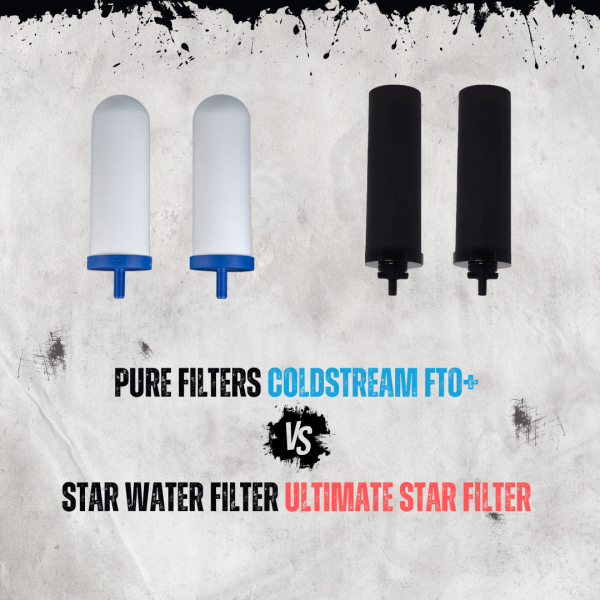
Pure Filters vs Ultimate Star Filter
In the world of gravity-fed water filters, there are many marketing promises but not all of them are equal.
At Pure Filters, we have always favoured absolute transparency and independent validation of our performance. Today, true to our approach, we objectively compare the tests of Pure Filters equipped with the Coldstream FTO+With those of the emerging Ultimate Star Filters.
Our Goal : Enable you to clearly distinguish between enticing claims and truly proven performance, so you can make an informed and responsible choice.
Important note : A lab test is not a certification.
We prefer reports carried out by ISO/IEC 17025 accredited laboratories and following NSF/ANSI protocols (42, 53, 401, P231) for drinking water. Example side Coldstream FTO+ (CF163W): tests under 42/53/P231 by IAPMO/Envirotek, on 3,000 L, with publication of a detailed performance sheet.
Conversely, SGS Xiamen reports published by Star Filter are labelled "for scientific research and internal quality control only – not for product certification", and are not covered by ISO/IEC 17025 accreditation for the performance of domestic filters. They remain informative, but not certifying.
Update – September 16, 2026: What has changed, what hasn't changed
Since our last update, Star Water Filter (SWF) has redesigned its results page (dated August 26, 2026). We downloaded all the reports published there — SGS-CSTC Xiamen, ALS — as well as the NSF public database sheets, and we read them down to the footnotes. Here is what we remember, in order: first what has improved, then what the documents actually say. Each section ends with an explanation in plain language, for readers who do not frequent the standards every day.
1. What has improved, and which we note without reservation
• Chemical results are now presented in multiple volumes (start-up, 750, 1,500, 2,250 and 3,200 L), with one PDF per contaminant in direct access.
• The laboratories are named (SGS-CSTC Xiamen, ALS) and the analytical methods for metals and PFOA/PFOS are those expected in drinking water: EPA 200.8 by ICP-MS, EPA 537.1 by LC-MS/MS with a limit of quantification of 10 ng/L.
• Heavy metals are tested at NSF/ANSI Standard 53 input concentrations, at two pH levels (6.5 and 8.5), and the output values are well below the thresholds of the standard. On these one-time measurements, there is nothing to complain about.
• The results page states that an analysis "with reference to" NSF/ANSI 53 does not constitute certification, and that the NSF/ANSI 42 cartridge certification is for materials. That's right, and it's an improvement over the formulations we were seeing in January.
Our original paper stated that the chemical tests published were for single volumes of 10 L. For chemistry, this is no longer the case, and we are correcting it.
In other words. A laboratory report is a balance: it is more or less accurate, and we don't weigh the same thing depending on what we put on it. For heavy metals (lead, arsenic, copper, cadmium, etc.) and for the two most well-known PFAS (PFOA, PFOS), SWF used a good scale, with the right reference weights. When the filter is new and we present it with lead-laden water, it retains the essentials. We recognize it: it is not a product that does not filter anything. What the following sections look at is what happens after the first drink.
2. What the test protocol says
All published SGS and ALS reports describe the same method. About SMS reports: « RO water is continuously fed at a flow rate of 1.5 L/min throughout the process. At start-up, 750 L, 1500 L, 2250 L, and 3200 L of the service life, the influential spiked water is prepared […] and the removal rate is then tested at a flow rate of 0.15 L/min. » In French on ALS annexes: "The prepared reverse osmosis water is applied in a continuous flow to the flow-controlled filter. At different test intervals […], the post-process residual water is analysed. » The SGS reports add: "Refer to client's method", and the ALS Schedules: "used in accordance with the protocol for use provided" by the customer.
A carbon filter works like a sponge: it retains pollutants until saturation. Testing your endurance means measuring how much water polluted it absorbs before it gets tired. This is what the protocol applied to the CF163W (FTO + Coldstream) does : 3,000 litres of water voluntarily loaded with contaminants, in gravity, 40 litres per day for several months, with regular measurements to observe when the filter runs out.
The reports published by SWF describe another method. . The filter receives 3,200 liters of reverse osmosis water — Pure, contaminant-free water — at a flow rate of 1.5 L/min, i.e. ten times the gravity flow, which takes about 36 hours. At five moments, it is presented with polluted water and what comes out is measured. Between these five measurements, the filter has retained nothing: it is, each time, almost new.
Both methods result in five-column tables that look similar. They don't tell the same story : one follows an aging filter, the other measures a clean filter five times. We can see it in the reports: for several drugs, the results are identical to the tenth from the first to the last level — which never happens with a continuously loaded filter.
In concrete terms, this changes the reading of a figure that the two brands display: "3,000 liters". On the CF163W (FTO+) side, 3,000 liters of contaminated water are actually filtered in the laboratory, with performance measured at the end of this volume — and a replacement recommendation set at 1,500 L, i.e. half of what was tested. On the Ultimate Star Filter side, there are 3,200 liters of pure water followed by five measurements on a clean filter — and an announced life of 3,000 L per cartridge that none of the published reports have put to the test. The first figure is a measured capacity. The second is a declared capacity.
In other words. Imagine wanting to know how many kilometres a pair of shoes can last. The first method: walk 3,000 km in them, and look at the condition of the soles every 500 km. The second method: leave the shoes under a tap of clear water for 36 hours, then take ten steps in them five times and see that they are in good condition. Both methods produce a five-line table. Only one tells you if the shoes will last the year.
3. Microbiology has not changed
The only microbiological reports published remain those of December 2024 (SGS Xiamen, MS2 coliphage and Salmonella), under Chinese sanitary standards, at an imposed flow rate of 0.15 L/min. The Salmonella report indicates, at 1,500 L, an outlet concentration of 3.3 × 10³ CFU/mL for an inlet of 9.8 × 10⁵ — then < 1 to 3,000 L. These reports, like all published SGS-CSTC reports, include: "this test report shall only be used for scientific research, technical research and development, teaching, and internal quality control".
For reference, the CF163W is tested under NSF P231 protocol (bacteria, viruses, cysts) up to 3,000 L.
In other words. "CFU/mL" is the number of live bacteria per milliliter. 3,300 per milliliter is 3.3 million per litre, or about 800,000 salmonella in a 25 cl glass of water taken out of the filter, at mid-life. The same report then states " less than one per milliliter 3,000 L: a filter that lets a lot pass through halfway through and then nothing at the end of its life, it's not a filter behavior, it's the sign of a single measurement, without repetition. The NSF P231 protocol is designed for purifiers: it requires the filter to trap 99.9999% of bacteria and 99.99% of viruses At all measuring points, including at the end of its life, with water that has been deliberately made difficult (cold, cloudy, loaded with organic matter). It is this protocol that the CF163W (FTO+ Coldstream). Finally, the bolding on each SMS report means that the laboratory itself is reserving these documents for internal use, not for commercial demonstration.
4. Input concentrations, limits of quantification, European standards
A percentage reduction depends on two things: the concentration injected and the fineness of the instrument. Some examples from the published reports:
|
Substance |
Starter |
Output / LOQ |
Benchmark |
|
TFA |
1,000 μg/L |
27 to 31 μg/L measured |
European tap water: 0.1 to 10 μg/L; NL guide value: 2.2 μg/L |
|
PFHxA |
1,000 μg/L |
< 10 μg/L (LOQ) |
EU limit, sum of 20 PFAS: 0.1 μg/L |
|
Glufosinate |
1,107 μg/L |
24 to 38 μg/L measured |
EU limit per pesticide: 0.1 μg/L |
|
Methoxychlor |
129 μg/L |
< 1.9 μg/L (LOQ) |
EU limit: 0.1 μg/L |
|
Chlordecone |
195 μg/L |
< 1 μg/L (LOQ) |
EU limit: 0.1 μg/L |
|
Estradiol |
192 μg/L |
< 0.1 μg/L (LOQ) |
Actual levels: in the range of ng/L |
A 97% reduction on TFA dosed at 1,000 μg/L leaves the outlet water with a higher load than unfiltered tap water. A LOQ of 10 μg/L cannot demonstrate compliance with a limit of 0.1 μg/L. These figures do not say that the filter is bad; they say that the test, as it is constructed, does not allow us to conclude.
In other words. Two notions are enough. Input concentration : If you pour a kilogram of salt into a carafe and the filter holds 970 grams, you'll read "97%" — but there's still 30 grams of salt in your glass, much more than in tap water. This is exactly the case with TFA: the "filtered" water in the test contains three to ten times more TFA than the tap water of the average French person. The limit of quantification (LOQ) : this is the smallest weight that the scale can read. A kitchen scale that stops at 10 grams will show "0" for 9 grams of poison. For PFHxA, the scale used stops at 10 μg/L, while the European limit is at 0.1 μg/L: the outlet water could contain a hundred times the standard and the ratio would still show "< 10" and "> 99%". For methoxychlor and chlordecone, the scale is ten to twenty times too coarse for the standard. The percentage is true; it simply does not answer the question "is this water compliant?"
5. 5 μm particles and "membrane"
The SGS report of February 24, 2026 (test subcontracted to SAE Technologies, Dongguan) measures 5 μm polystyrene beads: 229 particles/mL at the outlet at 2,250 L, 556 at 3,200 L. SWF's FAQ describes a "nanofiltration membrane" that retains "up to 0.001 μm". A nanofiltration or ultrafiltration membrane does not allow particles several thousand times larger than its pores to pass through. An electro-adsorbent media such as Disruptor (Ahlstrom, physical pores from 1.2 to 1.5 μm) does not allow them to pass through either.
On the "NASA" parentage, the documented facts are as follows: the NanoCeram technology was developed by Argonide with the support of NASA's SBIR program, then licensed exclusively to Ahlstrom under the name Disruptor; this media equips the ÖKO water bottle. To our knowledge, SWF does not publish any document identifying its membrane as a NanoCeram, Disruptor/Ahlstrom media or a licensed technology resulting from this filiation.
In other words. A micron (μm) is a thousandth of a millimeter. A "0.001 μm" membrane would have holes five thousand times smaller than a 5 μm ball — it's a tennis ball facing the cat of a needle. It can't get through. However, the report counts 556 beads per milliliter in the outlet water. There are only two explanations: either the water bypasses the membrane, or the membrane described is not the one in the cartridge. As for the "NASA technology": there is indeed a filtering media from a NASA program, it is called Disruptor, it is manufactured by Ahlstrom, and it is perfectly identifiable. Nothing in the SWF documents links his cartridge to this media.
6. NSF Certification: Both plugs, side by side
We consulted the NSF public database (listings.nsf.org) on September 15 and 16, 2026.
|
|
Ultimate Star Filter USF-SWF-001 |
Coldstream CF163W |
|
Standard |
NSF/ANSI 42 |
NSF/ANSI 42 |
|
Category |
Components : Filter Cartridge |
Components : Filter Cartridges |
|
Performance claims |
N/A |
N/A |
|
NSF Rating |
"Conforms to NSF/ANSI standard 42, material requirements only" |
"Conforms to material requirements only" |
|
Holder |
Premium Water Distribution, Toulouse |
KLT Filtration DBA Coldstream, Norfolk |
|
Production site |
"#1 China" |
Norfolk, United Kingdom |
Both cartridges are NSF/ANSI 42 certified for materials only. Neither is NSF certified for contaminant reduction. The statement "the only NSF-certified activated carbon gravity filter" on the SWF homepage is therefore inaccurate: the CF163W has the same certification, under the same standard, in the same category. The difference between the two sheets is one line: the production site.
In other words. "NSF 42 certified, materials only" means one thing: the cartridge does not release harmful substances into the water and holds mechanically. It's the equivalent of the "glass and fork" pictogram on a food container — it guarantees that the can is healthy, not that what's inside is good. This certification says nothing about the filter's ability to retain lead, pesticides or bacteria: for that, it would require an NSF 53, 401 or P231 certification, which neither SWF nor KLT has applied for. On this point, the two cartridges are exactly equal. What distinguishes them is that one is manufactured in the holder's factory, identified by NSF, and the other in an anonymous site in China. "NSF Certified" is true on both sides; "the only one" is false.
7. What we correct in our own text
• We wrote that the SGS Xiamen reports "do not fall under ISO/IEC 17025 accreditation". The exact wording is: accreditation is not indicated on the published documents, and the reports are marked as "internal research".
• We wrote that the chemical tests were only on 10 L. They now cover five levels, according to the protocol described in point 2.
In other words. We apply to our own texts the rule we apply to others: when a document contradicts what we have written, we correct it, and we say so.
In summary
The question is no longer "are there tests?" — there are tests on both sides. The question is: under what conditions, with what water, for how long, with what instruments, and under what usage label. We publish the CF163W's Envirotek/IAPMO reports in full; everyone can read them with the same questions.
In other words. Before you buy a filter based on a "99%" rating, ask five questions: Was the test water continuously polluted or only at the time of the measurements? At what flow rate? At what inlet concentration, compared to your actual water? With what instrument accuracy, compared to the standard? And does the laboratory allow commercial use of its report? A manufacturer who meets all five has nothing to hide.
Update – November 2025: New Star Filter Tests and Deceptive Testing Protocol
Since the initial publication of this article, Star Filter has released new laboratory reports dated 2025, carried out by SGS-CSTC Xiamen Branch, a regional subsidiary of the SGS Group in China. These documents are presented as "endurance tests" conducted on 3,000 to 3,200 liters, indicating reductions of more than 99% for various contaminants (heavy metals, PFAS, bacteria and coliphagous MS2 virus). The reports, however, specify that they were carried out "for internal research purposes" and "without certification value".
What these tests really reveal:
• All SGS Xiamen reports mentioned are internal tests, not certifying.
• The methods discussed (GB/T 5750, EPA 537.1, EPA 1602) are analytical methods (measurement of concentrations), not filter performance standards such as NSF/ANSI 42, 53, 401 or P231.
Contrary to what is stated on the Star Filter website, the SGS Xiamen reports provided do not establish an ISO/IEC 17025 accreditation applicable to the tests presented; on the contrary, they indicate an "internal research" use and the absence of certification value.
In other words: exploratory tests, non-certifying, in a non-accredited framework.
Star Water Filter: "NASA membrane" or carbon + UF 0.01 μm combo ?
To our knowledge, there is no evidence that Star Filters uses Ahlstrom/Argonide Disruptor media (sometimes referred to as "NASA technology").
Ahlstrom's technical documents describe an electro-adsorbent nonwoven, not a 0.001 μm membrane. The characteristics announced by Star Filters and the industrial indices observed correspond rather to OEM cartridges of the carbon block + UF 0.01 μm membrane type.
What the technical sources say :
• Disruptor by Ahlstrom/Argonide is an electro-adsorbent non-woven media based on nano-alumina; the retention of submicron particles is done by charge, with an average size of physical pores around 1.25 μm — we are not at all on a "0.001 μm membrane".
• The "NASA" storytelling refers to historical SBIR funding of Argonide, which was then taken over under exclusive license by Ahlstrom (Disruptor). Again, there is no indication that Star Filter has a license on this medium.
Concrete clues (visuals and market) :
• The cross-section photo provided by SWF shows a dark block (agglomerated carbon) with a pleated central element type UF, the classic signature of OEM "carbon + UF 0.01 μm" cartridges.
• The sheets and reports that SWF highlights align with Chinese OEM grammar (carbon + UF 0.01 μm block, "tested by SGS Xiamen", volumes 3,000–3,200 L, flow drops at end of life).
Interim conclusion :
• Likely charcoal + UF 0.01 μm combo. No public evidence of a Disruptor media "NASA technology" used by Star Filter. If SWF publishes a media number, Ahlstrom/Argonide license, or NSF/ANSI type certifying reports, we will update.
Contradictions noted on the SWF website (end of November 2025) (examples noted by us) :
• Product sheet: "nanofiltration membrane up to 0.001 μm", PF-2 compatibility, flow rate 12 L/h and 6,000 L per pair, "retains minerals".
• FAQ/Blog: Recurring claim of a "NASA-developed membrane", 0.001 μm, presence of silver (in the coal and/or membrane).
• About the NSF: on the one hand "all components are NSF certified; the filter is in the process of certification"; on the other hand "the only NSF certified activated carbon based gravity filter".
Why is it stuck ?
• "0.001 μm" is a typical claim of pressurized nanofiltration/RO. In gravity, without a pump, a true NF 0.001 μm would have a flow rate of almost zero — the opposite of the announced flow rates.
• The Disruptor technology (if it were it) is not a "0.001 μm membrane" but a non-woven electro-adsorbent media; talking about "NASA 0.001 μm membrane" maintains confusion.
• On the NSF side, a product is never "NSF certified" en bloc: each model is certified, if it is, for specific claims (materials, chlorine, lead, P231, etc.). Generic or contradictory formulations must be clarified by the brand.
A biased comparison with Coldstream
Star Filter also published an SGS Xiamen test on a Coldstream FTO Plus (CF163W) filter, concluding that it "does not effectively filter viruses".
However, this test was not commissioned by Coldstream and its protocol is questionable:
• Total volume: 100 L only.
• Influent viral concentration: 4.2×10⁵ PFU/mL. For reference, theU.S.EPA (1987), the basis of NSF/ANSI P231, prescribes a challenge of 10⁷ PFU/L, or 1×10⁴ PFU/mL. The SGS test applied to CF163W therefore used a load ~42× higher than this benchmark, and ~17× higher than the load used in the KLT/Coldstream rotavirus tests (2.4642×10⁷ PFU/L), which show > 99.99% reduction up to 3,000 L.
• The "EPA Method 1602" cited is a method for counting coliphages; it does not set an influent concentration to evaluate the performance of a purifier.
• 4.2×10⁵ PFU/mL (i.e. 4.2×10⁸ PFU/L) exceeds the high range frequently reported for raw wastewater (10⁶ PFU/L), which makes the comparison with domestic use of little interest.
Meanwhile, the tests carried out on the Star Filters themselves (SGS 2025) have been conducted under much more favourable conditions (volumes 3,000–3,200 L, "reasonable" loads), and remain unaudited internal tests. Two protocols, two realities: realistic and advantageous for their products; extreme and unrealistic for Coldstream.
What to remember
The difference is not a simple deviation in method: it reflects a double standard. The same players choose "reasonable" measurement conditions for their own filters, but extreme conditions for a competitor. Conversely, Coldstream tests performed by Envirotek/IAPMO (ISO/IEC 17025 accredited laboratories) comply with NSF/ANSI P231 protocols and show a viral reduction > 99.99% at 3,000 L, under prescriptive and verified conditions.
Correction of fluoride and nitrate claims
Star Filter claims that Coldstream FTO+ filters "do not filter fluorine or nitrates." This presentation is incomplete.
Fluorides: real reduction but strongly dependent on volume and load
• Fluorides (F⁻) are anions that are difficult to capture. Coldstream tests (CF163W) show a high reduction at the beginning (≈ 97.5% in the first liters), still ~90% around 500 L, then a marked drop to ~17% at 3,000 L, with "challenge" water dosed at 8.8 mg/L F⁻. In typical real water (0.1–0.5 mg/L), saturation appears later and performance is maintained for longer.
Nitrates: measured and sustainable reduction (without dedicated resin claims)
• Contrary to the "no reduction" claim, Coldstream data for CF163W shows a reduction in nitrate (NO₃⁻) of approximately 66% at 500 L and ~60% at 3,000 L for water spiked at 29.7 mg/L NO₃⁻. Coldstream does not claim the use of nitrate-specific ion exchange resins in its consumer data sheet; however, the reduction observed is measured in the laboratory and published.
Understanding Coldstream FTO+ Filtration Results
In summary, Coldstream FTO+ filters (*) are not aimed at "distilled water", but at purified and balanced water: priority is given to microbiological safety (P231) and the documented reduction of a wide spectrum of contaminants (NSF/ANSI 42, 53), while maintaining natural minerality. The referenced tests are conducted under NSF/ANSI standards 42, 53 and P231 by an accredited laboratory (Envirotek/IAPMO).
Technology: Star Filter vs Coldstream
Star Filter :
• Most likely architecture: sintered activated carbon block + integrated 0.01 μm UF membrane (polymer), typical of Chinese OEMs; operation by adsorption + UF sieving; progressive clogging not "recoverable" by brushing.
Coldstream FTO+ (CF163W) :
• Brushable ceramic shell + internal activated carbon; external microbio barrier, internal adsorption for chemicals; regular cleaning possible, more stable flow over time.
Star Filter :
- SGS Xiamen report series on 3,000–3,200 L (metals, PFAS, bacteria, MS2, etc.). Useful but explicitly non-certifying reports ("for research/internal QC only").
Coldstream FTO+ :
- Testing and certification via IAPMO/Envirotek, under NSF/ANSI 42/53/401/P231/600 standards, with publication of 3,000 L performance sheets.
- P231 (microbiology): 6 log bacteria and > 4 log viruses tested up to 3,000 L, as part of the purifier protocol.
- 42/53/401 (chemicals): high reduction over a wide range (VOCs, SVOCs, HAA5, pharmaceuticals), always measured at 3,000 L; see CF163W data sheet.
PFAS: what evidence can be relied on ?
For PFAS, we rely primarily on the historical ProOne trials conducted by Envirotek (ISO/IEC 17025) including P-473 (PFOA/PFOS), at the time when ProOne marketed the cartridge manufactured by KLT Filtration (*) (Coldstream). These reports, even if they are in the name ProOne, describe the performance of a media identical to that subsequently used by Coldstream FTO+ on this time segment.
In practice: ProOne results cover PFAS, 42/53/401 and P231 (50 gallons on P231 in this protocol), and serve as an independent anchor to PFAS where published Coldstream FTO+ sheets do not always display the PFAS line in plain text.
Critical reading of SWF's published SGS reports :
• Reports often advertise "> 99%" on contaminant batteries up to 3,000–3,200 L, but with a single sample and analytical methods (GB/T, EPA 1602, 537.1) outside of the certification protocol.
• The mention "for scientific research and internal quality control only – Not for product certification" limits the use of these documents in direct comparison with NSF/IAPMO certificates.
• Example virology (MS2) and bacteria (Salmonella): high reductions announced, but "standard disinfection" protocol and imposed flow rate (0.15 L/min) — this is not a standardized gravity protocol of the P231 type.
Our position at the end of November 2025
• On the technology: in view of the Ahlstrom/Argonide technical documents and the industrial indices (visuals, flow rates, test volumes, OEM grammar), Star Filter is most likely based on a "carbon block + UF 0.01 μm" design and not a "0.001 μm membrane" NASA/Disruptor.
• On the evidence: SGS Xiamen reports are useful but not certifying; we prefer accredited and normative tests to compare commercial claims, which is published by Coldstream (IAPMO/Envirotek) and, for the historical PFAS, ProOne.
Clear conclusion for the reader : If you want a gravity filter with strong prescriptive evidence over time (3,000 L tested) and readable technology, Coldstream FTO+ ticks the most boxes today, with IAPMO/Envirotek reports and an exhaustive scorecard.
On the Star Filter side, the positioning is mainly based on "membrane/NASA/0.001 μm" communication and internal SGS reports. This does not prove inefficiency, but it is not at the same level of demonstration or traceability. We will remain open to any future publication of media licenses, patent numbers, NSF/IAPMO certificates and full high-volume reports.
For more information:Lab Testing – Coldstream Water Purifier
Methodology and standards used
Pure Filters equipped with the Coldstream FTO+:
- Independent laboratory: Envirotek Laboratories (USA), EPA and IAPMO accredited.
- Standards applied: NSF/ANSI Standard 42, 53, P-231, and 401.
- Tested volume: up to 3000 liters, with readings every 500 liters.
- Scientific rigor: details provided for each substance tested, by volume band.
FTO +Haloacetic Acids Reduction Testing: Passed
Gravity Filters FTO+ TEST REPORT
Star Water Filter equipped with Ultimate Star Filter :
– Wessling France (ISO 17025 accredited): triplet chemical tests on doped demineralized water, unit volume 10 L, flow rate 150–250 ml/min.
– SGS Xiamen (China): microbiological tests and some spot tests on 10 L; ISO 17025 accreditation is not indicated in the documents we have received. Variant if you validate the proof of lack of accreditation: "non-ISO 17025 accredited laboratory".
– Remember: the chemical tests published are for initial volumes (10 L). They do not document the stability of the results over the claimed lifetime.
SGS STARFILTER Laboratory Test
Review of WESSLING FRANCE STARFILTER via the website https://starwaterfilter.com/fr/content/10-resultats-d-analyses-du-filtre-ultimate-star-filter
SGS STARFILTER BACTERIA Laboratory Test
SGS STARFILTER VIRUS Laboratory Test
SGS STARFILTER SALMONELLA Laboratory Test
The tests come from the official Starfilters website https://starwaterfilter com/faq
To date, the chemical tests published by Star Water Filter are based on single volumes of 10 L of doped water; they do not document the stability of the results over the lifetime." Technical justification: the Wessling v2 report describes tests on doped demineralized water, in triplicate, and specifies that the synthesis includes the best of the three results; this document does not include chemical resistance tests on cumulative volumes.
Series of contaminants tested and significant results
Pure Filters equipped with Coldstream FTO+ :
• Very broad spectrum: volatiles, metals, pesticides, pharmaceuticals, herbicides, microorganisms, inorganic compounds.
• Very wide spectrum covered, with stepwise readings up to 3000 L according to the laboratory documentation provided by the manufacturer. It is this type of tiered protocol that makes it possible to certify performance over time.
Star Water Filter equipped with Ultimate Star Filter :
• Tests on PFAS, drugs, plasticizers, solvents, hormones, heavy metals.
• Wessling v2 publishes high abatements in the laboratory (PFAS, plasticizers, disinfectants, solvents/HVOC, drugs, hormones, metals), presented as the best result among three parallel tests on 10 L doped cells. Some values are more modest depending on the case (e.g. p,p'-DDE; selenium at pH 6.5; barium at pH 8.5).
Seriousness and credibility of the tests
Both brands publish trials aligned with known standards (NSF/EPA for Coldstream; NSF/ANSI referenced in the Wessling protocol for Star). The difference is mainly due to accreditation and time depth:
– Coldstream FTO+: multi-stage tests up to 3000 L.
– Star Water Filter : chemistry tested by Wessling, ISO 17025 accredited laboratory; part of the tests were also carried out by SGS Xiamen, without mention of ISO 17025 on the documents provided.
As a result, robustness "over time" is demonstrated at Coldstream FTO+, while the excellent Star Wtaer Filter abatements published at 10 L do not prejudge the resistance at 1500–3000 L.
Why the identity of the filter under test is essential : We do not doubt the authenticity of the SGS reports received. The membrane announced by Star WF is internal, it is normal that it is not visible in external photos. On the other hand, Star WF does not publish a photo of the actual cross-section of the media; only a model is proposed. Given the superior performance compared to that of a conventional activated carbon block on several families, we would like more visual transparency on the exact composition, only to strengthen confidence.
Synthetic comparison
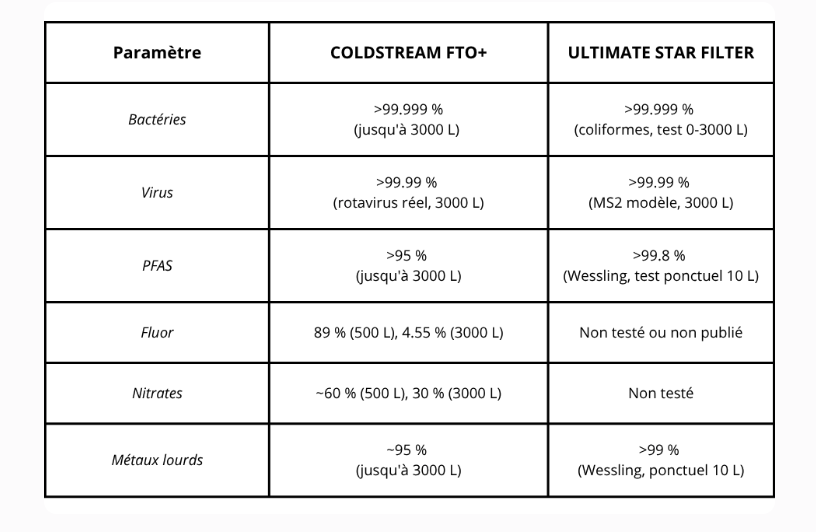
Comparing Performance on Viruses: What the Tests Really Say
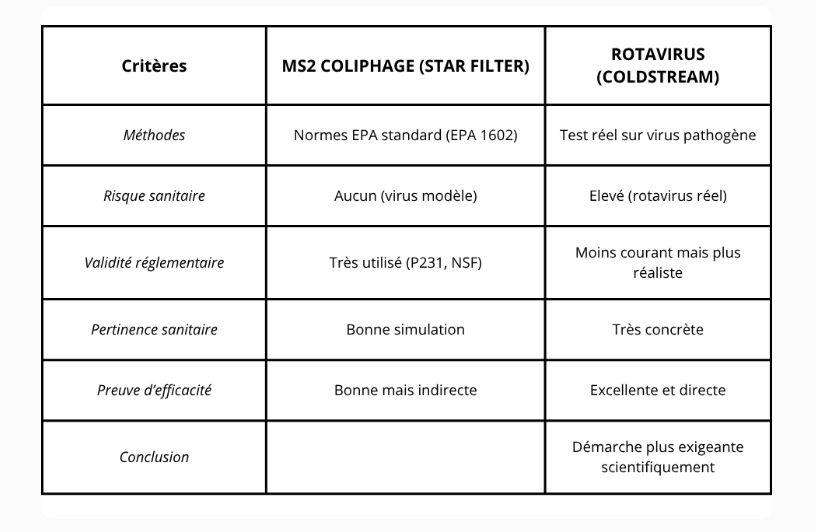
The MS2 virus test, used to certify the Starfilters filter, is a standardised and valid approach based on a non-pathogenic virus. For its part, Coldstream has tested its filters on a real virus, rotavirus, offering direct proof of the elimination of a pathogenic virus. This reflects a more committed, but also more scientifically demanding approach.
Virological tests are often difficult to compare because laboratories use different models. Here is a summary table to better understand the difference between the test used by Starfilters (MS2 Coliphage) and the one used by Coldstream (Rotavirus).
Comparing performance on bacteria: what the tests really say
Microbiological performance is essential for any gravity filtration system. But to interpret it correctly, it is also necessary to examine the methodology used.
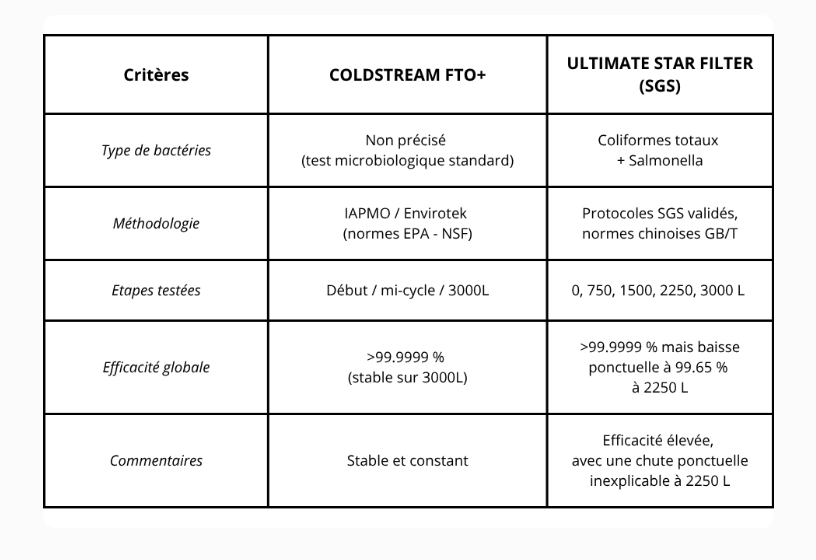
The table below compares the results obtained on bacteria from the Coldstream FTO+ filters (Pure Filters) and Ultimate Star Filter (Starfilters), based on their respective laboratory reports.
Coldstream tests were carried out by Envirotek Laboratories (USA), according to EPA and NSF standards, with a documented efficiency up to 3000 liters.
The Starfilters tests were conducted by SGS, following Chinese health standards (Ministry of Health, GB/T standards). They show a high initial efficiency (>99.9999%), but a visible drop mid-cycle, particularly at 2250 L.
This comparison is not intended to disqualify one method in favor of another, but to allow everyone to understand what was actually measured, and under what conditions.
This is shown on pages 6 to 14 of the Eurofins report :
Subject: REACH control of 247 SVHC substances in homogeneous cartridge materials (T1: PP cover + silicone gasket + EVA glue; T2: non-woven; T3: activated carbon rod). Internal analytical methods (GC-MS, LC-MS, ICP-OES, UV/VIS, IC), detection limit 0.010% m/m. Result: not detected for all SVHCs tested on T1/T2/T3, i.e. "PASS" with regard to the REACH threshold 0.1%. These tables list the ECHA candidate list; they do not measure filtered water or pollutant abatement.
Conclusion
The Wessling v2 tests published by Star Water Filter describe a high initial performance on doped water, in triplicate, with the presentation of the best result for each family. This is useful for characterizing a potential for abatement, but it does not demonstrate chemical resistance over hundreds or thousands of liters. For their part, the FTO+ documents are based on protocols with follow-up in stages up to 3000 L, which makes it possible to evaluate stability over time.
For its part, Star Water Filter shows very promising performance, particularly on the microbiological part, but only on the initial phase or without clear demonstration of stability over time for chemical contaminants and heavy metals.
To date, on the chemistry side, the tests published by Star Water Filter concern single volumes of 10 L of spiked water; chemical endurance data at cumulative volumes would be necessary to document the stability of the results.
Eurofins documents confirm material compliance with SVHC REACH (PASS <0,1 % sur T1/T2/T3). C’est positif pour l’innocuité des composants, mais distinct d’un test de performance de filtration de l’eau
Finally, since the Ultimate Star Water Filter filters are partly made of activated carbon, it is realistic to recommend, as with any filter of this nature – including the Coldstream FTO+ – a replacement every 6 to 8 months.
The difference is that Pure Filters clearly indicates this, consistent with laboratory results, while Ultimate Star Filters do not specify a realistic limit in their communication, and no test demonstrates stable effectiveness over time.
••• The tests in doped demineralized water (Wessling) isolate the media and produce very reproducible initial abatements thanks to the triplicate and the presentation of the best of the three results — a positive point — but they do not reflect either the complexity of real water or endurance over cumulative volumes — a negative point; conversely, the stepwise method up to 3000 L (Coldstream/Envirotek) documents the stability of performance over wear — a positive point — at the cost of longer and more expensive tests — a negative point.
•• It is important to remember that these filters are based on activated carbon, a material whose effectiveness decreases over time. An honest and objective recommendation would be to replace them every 6 to 8 months maximum, which corresponds to the technical reality and market standards.
• In addition, at the time of writing, the pair of Ultimate Star Filters is displayed at €150. Everyone will evaluate the value/price ratio in light of comparable technologies and published evidence.
Are you hesitating between several brands of filters? Don't miss the full analysis of "The old news": Gravity filters: which one makes water REALLY healthy ?
Official Star Water Filter sources:
– Wessling France, Laboratory expertise report – Ultimate Star Filter, report ULY-025013, version 2 of 14/08/2025: doped demineralized water, triplicate, presentation of the best result; flow rate 150–250 ml/min (10 L tank); reference to the raw results appendix ULY25-025013-2.
– Eurofins Testing Technology (Shenzhen), EFSN25040473-C-0101, 21/04/2025: REACH inspection of the 247 SVHCs on T1/T2/T3 materials, LOD 0.010%, PASS result < 0.1%
https://starwaterfilter.com/fr/content/10-resultats-d-analyses-du-filtre-ultimate-star-filter
Article "Ultimate Star Filter vs Pure Filters" (statements "NF 0.001 μm", "NSF soon") and "Performance"/product sheet page (NASA/0.001 μm claims)